


Anyone who has ever opened an Ahrefs or Semrush invoice and audibly sighed is basically the target audience for OpenSEO. It’s a new open source SEO platform that just launched on Product Hunt, and its whole pitch is refreshingly blunt: you get the same core workflows as the big paid suites — keyword research, rank tracking, backlinks, site audits — but you pay for what you actually use instead of handing over $100+ a month whether you touch the tool or not.
Why it exists
The story behind OpenSEO is a pretty relatable one. It was built by a developer named Ben, who’s said more than once that he started the project out of plain frustration — the existing SEO tools felt too expensive, too bloated, or, in his words, a little scammy. So he built his own. Since going up on GitHub, the project has picked up several thousand stars, and it landed on Product Hunt in July 2026 under the tagline “the open source Ahrefs alternative,” where it climbed to the top of that day’s leaderboard.
The philosophy underneath all of it is laid out on OpenSEO’s own case for open source: SEO software shouldn’t be a black box you’re stuck renting forever. OpenSEO is MIT-licensed, so anyone can pull the code, self-host it, or fork it into something totally custom. There’s still a hosted version for people who don’t want to babysit their own server, but the open source release is really what keeps that hosted product honest — if the pricing ever stops feeling fair, nothing stops you from spinning up your own instance instead.
What it actually does
Feature-wise, OpenSEO covers a lot of the same ground as the big incumbents, just split into cleaner, more focused tools instead of one sprawling dashboard. The full breakdown lives on their features page:
Keyword Research — throw in a seed term and it expands into keyword ideas with volume, difficulty, CPC, and intent, with live SERP results sitting right next to the numbers so you’re not researching blind.
Saved Keywords — a workspace for tagging and holding onto the keyword opportunities actually worth building content around.
Rank Tracking — keeps an eye on how your target keywords move over time.
Domain Overview — a quick way to size up a competitor’s organic traffic and see what they’re ranking for.
Backlink Checker — digs into referring domains and link quality (spam, broken, lost, nofollow) for your own site or someone else’s.
Site Audit — crawls a site and flags the technical and on-page issues dragging it down.
AI Visibility & Prompt Explorer — the newer, of-the-moment feature: tracking whether and how a brand gets mentioned or cited in AI-generated answers, and comparing how different AI models respond to the same prompt.
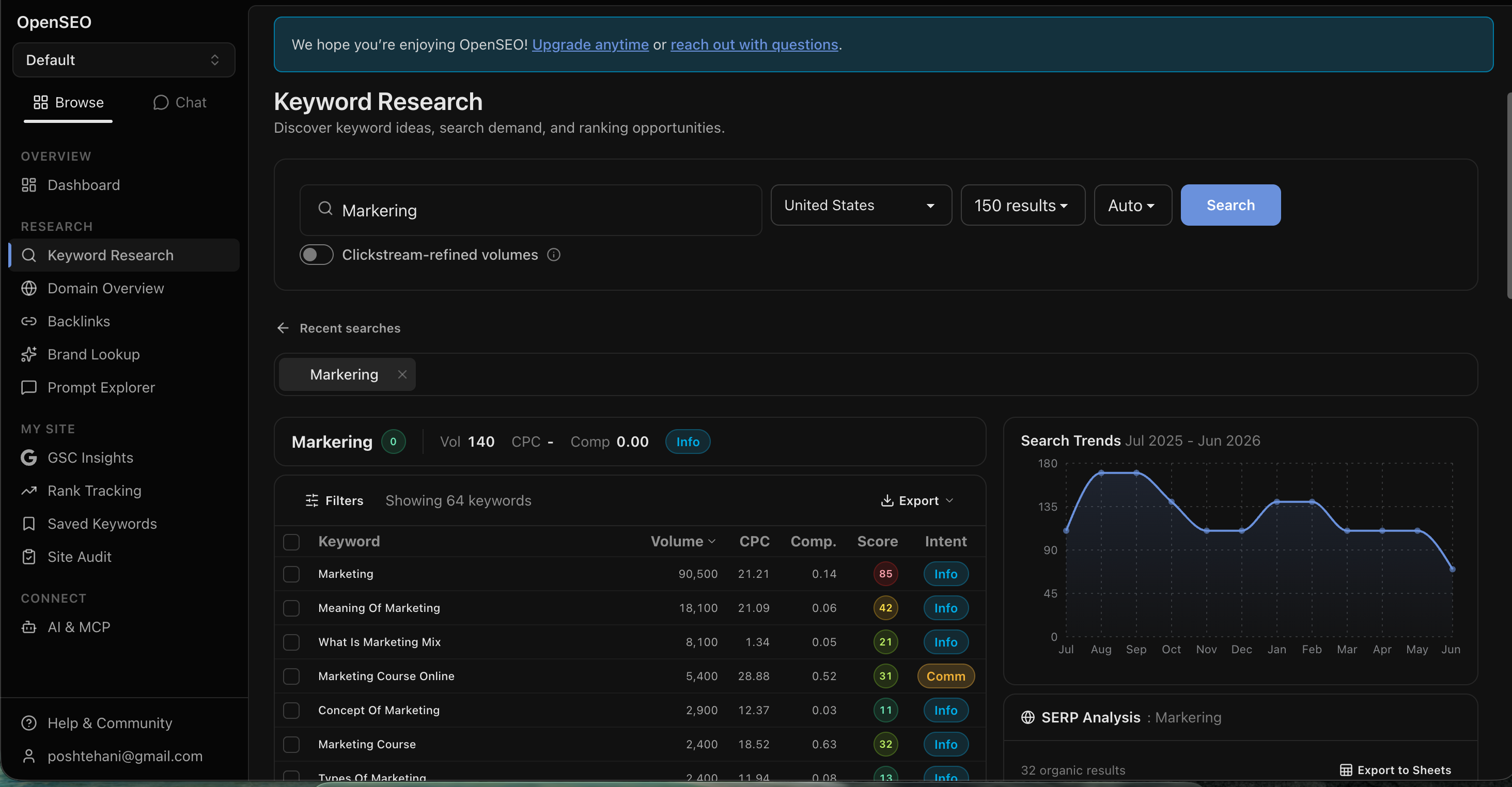
All of it runs on data from DataForSEO, a pay-as-you-go data provider, rather than some proprietary index OpenSEO built and locked behind a paywall — which is a big part of how they keep costs down.
The part that makes it feel current: AI agents
The feature OpenSEO leans on the hardest, and honestly the one that makes it feel like a 2026 product rather than a Semrush clone, is its native support for MCP, or Model Context Protocol. In plain terms, this means AI coding agents and assistants — Claude, Cursor, Codex, and others — can call OpenSEO’s tools directly in the middle of a conversation, instead of you copy-pasting spreadsheets back and forth between tabs. Ask an agent to research keywords for a topic, and it can pull live SERPs, check competitor domains, look at backlink context, and save whatever it finds straight back into your OpenSEO workspace so you can review it later.
There’s a second, separate MCP server just for Google Search Console, which gives an agent read-only access to clicks, impressions, CTR, position, and URL-inspection data — without you ever having to set up a Google Cloud project or wrestle with OAuth.
On top of the MCP servers, OpenSEO also ships pre-built “agent skills” — basically reusable workflow templates that walk a coding agent through common SEO tasks step by step, so it follows a tested process instead of improvising its way through your keyword research. Setup instructions for all of this are in the docs.
Self-host it free, or let them run it for you
Pricing follows naturally from the open source setup:
Self-hosted: free. Grab the code from GitHub, spin it up with Docker or deploy it to Cloudflare, bring your own DataForSEO API key, and pay DataForSEO directly for whatever data you pull.
Hosted: a small monthly subscription (around $10/month, from what’s published) plus usage credits that top up and don’t expire. The hosted version adds roughly a 28% markup on top of the underlying DataForSEO cost, in exchange for not having to run any infrastructure yourself. You can play with the numbers on their pricing estimator.
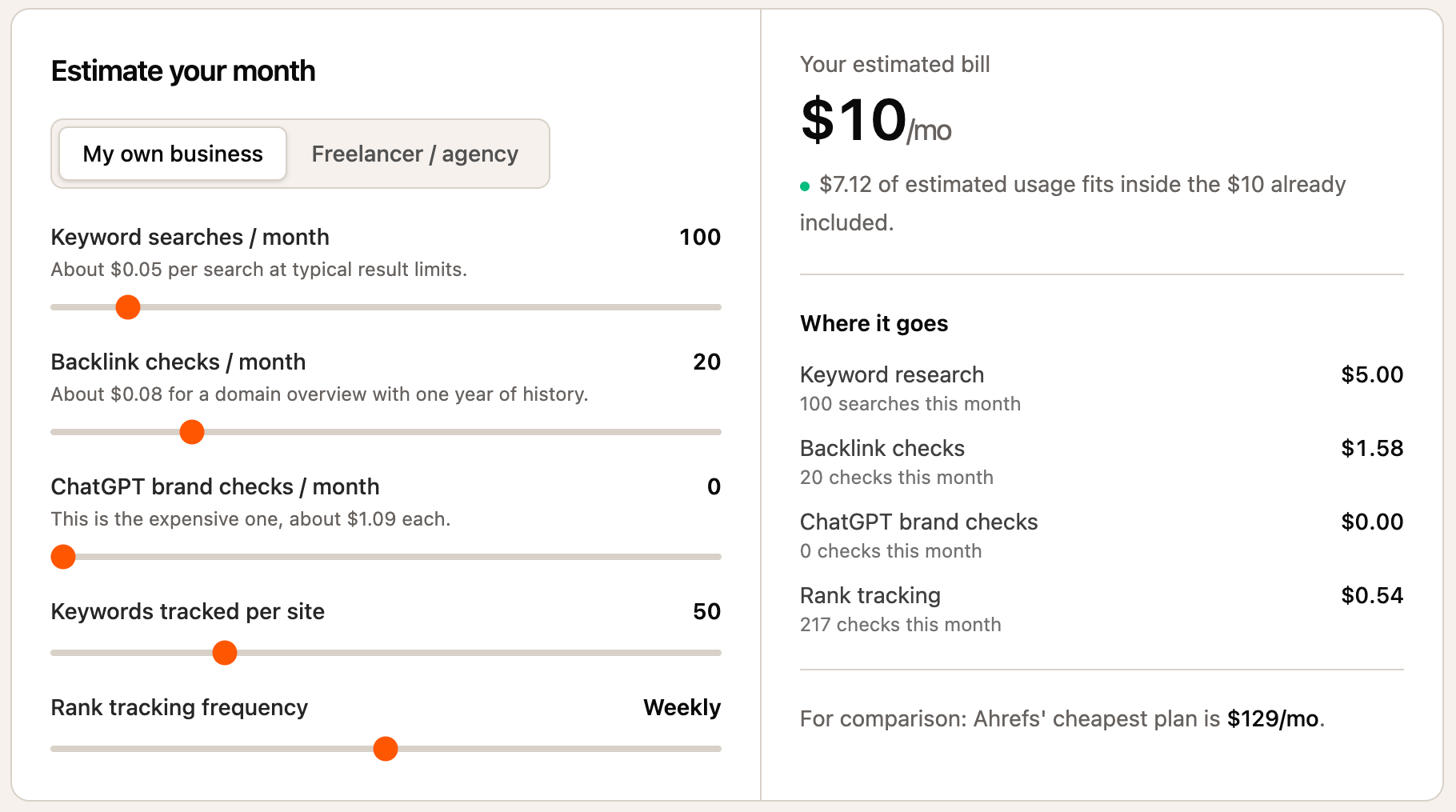
Either path skips the flat $100+/month tier just to get in the door — you’re paying something a lot closer to what the data actually costs.
Who it’s actually for
OpenSEO is aimed at people who’ve either been priced out of the big suites or are just tired of paying for a dozen features they never open: solo founders, small marketing teams, agencies juggling a handful of client sites. But it’s also very clearly aimed at developers. The project explicitly invites people to fork the codebase and build their own custom SEO tooling on top of it, on the logic that rebuilding keyword research or rank tracking from zero rarely makes sense when a working, open codebase is sitting right there.
The bottom line
OpenSEO isn’t trying to out-feature Ahrefs or Semrush checkbox for checkbox. It’s betting that most people don’t need the full weight of those suites, and that transparent, usage-based pricing paired with real AI agent access is just a more honest way to sell SEO software right now. Self-host it for free or pay for the hosted convenience — either way, the pitch stays the same: your data, your choice of infrastructure, and a bill that actually reflects what you used.
Check it out at openseo.so, poke around the source on GitHub, or see what people are saying on Product Hunt.